
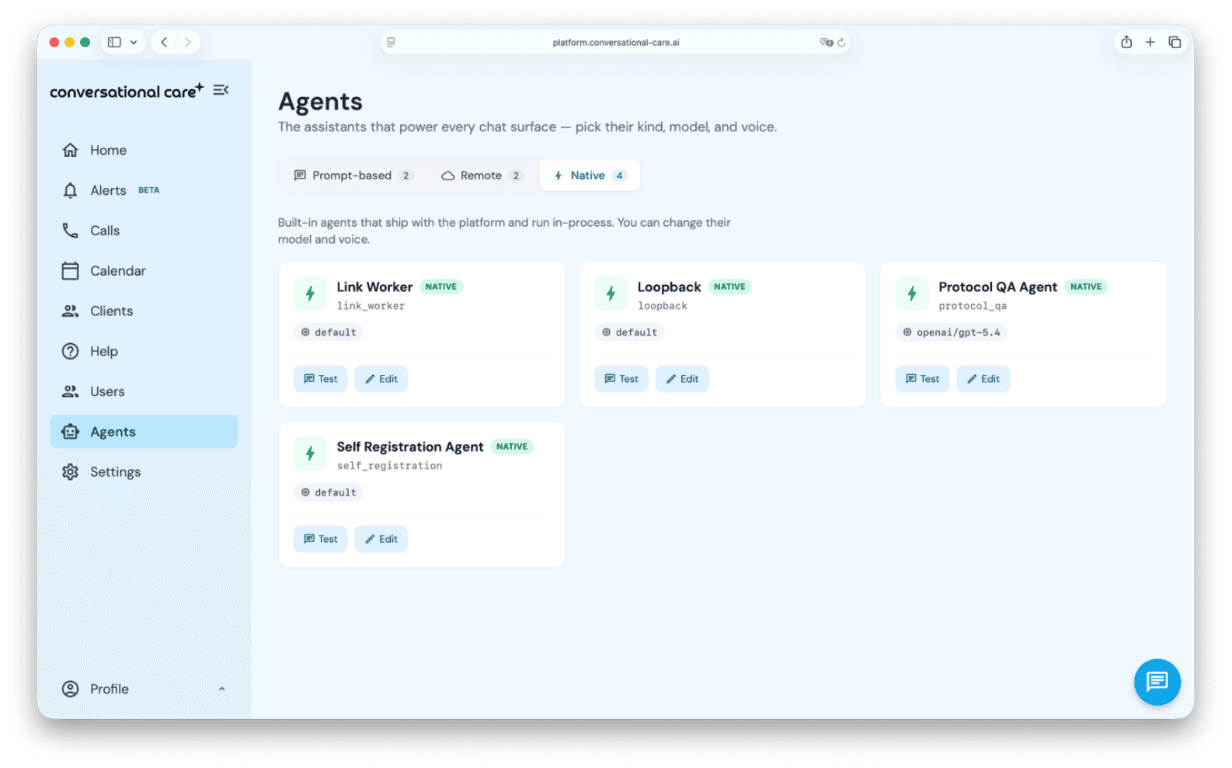
The Conversational Care platform’s agent dashboard.
This week, our paper “Conversational Care: Designing Responsible Human–AI Care Coordination” was published in the BritCHI 2026 proceedings. The paper will also be presented at the BritCHI 2026 conference in London, bringing together researchers and practitioners exploring how human-centred design can shape responsible digital technologies.
The paper is authored by Marco Da Re, Pablo A. Fonseca, Minseo Cho, Javier Sanchez, Alina Irina Serban, Francisco Diez-Canseco, Maria Sofia Cuba-Fuentes, Ravi Vaidyanathan, and Rafael A. Calvo, drawing on collaborative research conducted across the UK, Peru, and Singapore.
Designing AI for care, not just automation
Healthcare systems worldwide face growing demand, limited resources, and increasingly complex coordination needs. Conversational artificial intelligence offers new ways to support patients, families, carers, clinicians, and community health workers—but responsible deployment requires more than building a capable chatbot.
Conversational Care is a deployed, white-label platform for human–AI care coordination. It brings together reusable AI agents, communication tools, care records, scheduling, alerts, and escalation pathways, while keeping human oversight at the centre of care decisions.
The work was developed through a two-year Research through Design process involving 145 stakeholders across 14 roles. Participants included people living with dementia, carers, clinicians, community health workers, care navigators, monitoring teams, link workers, researchers, and designers.
Nine criteria for responsible conversational AI
The paper uses nine criteria to guide the design and evaluation of conversational AI in healthcare:
- Safety — operating without unacceptable risk to patients, clinicians, or health systems.
- Fairness — supporting people across diverse populations, identities, and circumstances.
- Effectiveness — improving care processes and outcomes rather than simply adding automation.
- Generalisability — adapting responsibly across settings, populations, and contexts.
- Usability and accessibility — enabling patients, carers, clinicians, and staff to use the system effectively.
- Human-centredness — respecting people’s values, goals, autonomy, and social contexts.
- Coordination — helping care teams, services, providers, and families work together.
- Conviviality — supporting meaningful human relationships rather than replacing them.
- Continuity — preserving information and relationships across time and changing care needs.
Rather than treating these principles as a checklist applied after development, the project used them throughout the design process. They became practical questions for workshops, prototypes, deployments, and reflection: What should be automated? What must remain human? Who can see the information? When should the system escalate? And how can people understand what the AI is doing?
What the project revealed
Across deployments in primary and community care, several design lessons emerged.
First, care teams need to define the boundaries of automation. Administrative, informational, and emotional tasks have different implications, and the appropriate boundary changes according to the needs and workload of each care team.
Second, a non-AI pathway must always remain available. People differ in their access needs, digital confidence, living situations, and willingness to engage with AI. Responsible systems should support—not penalise—people who choose human-only care.
Third, every channel of care should remain connected. Calls, alerts, messages, chatbot interactions, appointments, and in-person visits need to be presented together so that human and AI contributions can be understood in context.
Finally, AI should remain augmentative rather than substitutive. In care work, value is often created through trust, continuity, judgement, and relationships. Automation should reduce avoidable burden while protecting the human connections that make care effective.
From research to real-world systems
The platform has supported a range of care contexts, including dementia care, social prescribing, health coaching, and community health work. Its modular architecture allows organisations to configure agents, communication channels, escalation thresholds, and workflows for their own settings.
The research also highlights the limits of what can be claimed from early deployments. Conversational Care is not presented as a universal solution, nor as a substitute for clinical evidence or long-term evaluation. Instead, the paper offers a design account and a reusable approach for building and studying human–AI care systems in context.
Looking ahead
The publication marks an important step in an ongoing programme of work on responsible AI, healthcare, and human-centred design. Future research will examine effectiveness through deployment-specific evaluations, randomised controlled trials where appropriate, longitudinal studies of workforce effects, and further investigation of how stakeholder insights can be translated into reusable system features.
We look forward to presenting the paper at BritCHI 2026 in London and discussing how conversational AI can support care while preserving human judgement, accountability, and relationships.
