
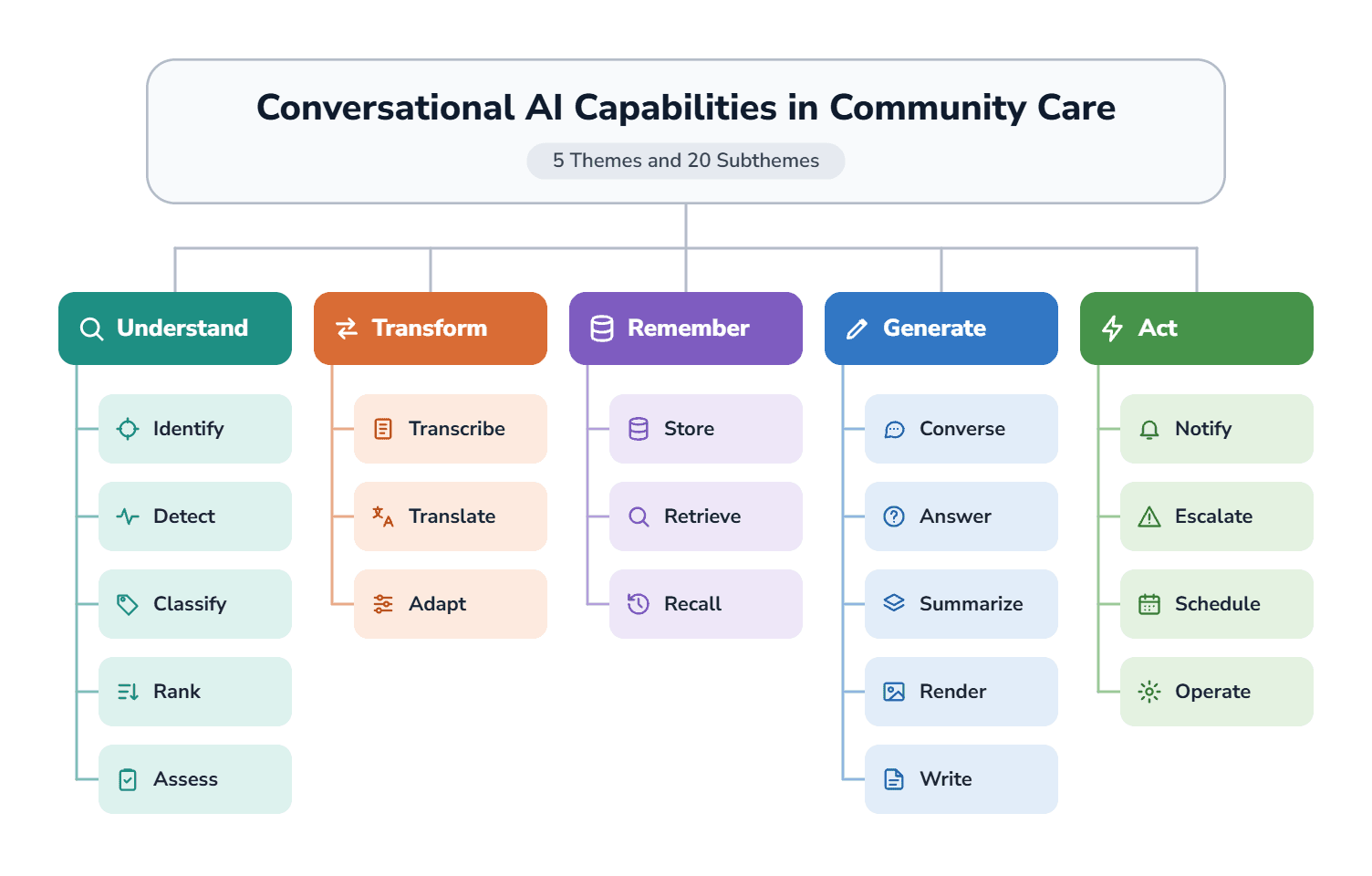
Conversational AI capabilities in community care: 5 themes and 20 subthemes.
We are pleased to share the publication of “Conversational Artificial Intelligence in Community Care: A Scoping Review” in the International Journal of Human–Computer Interaction.
The paper examines how conversational artificial intelligence (AI) is being used to support care beyond hospital settings.
As healthcare increasingly moves towards community-based services, conversational AI offers new possibilities for supporting patients, families and care professionals. But what can these systems actually do, and how should they fit into existing care practices?
Our review explores these questions by mapping the capabilities of conversational AI systems reported in community care research.
Mapping 20 capabilities across five domains
We reviewed 551 research records, ultimately including 29 studies published between January 2023 and June 2025.
From these studies, we identified 20 distinct conversational AI capabilities, organised into five functional domains:
- Understand: Interpreting information, identifying relevant details and detecting patterns in users' needs or circumstances.
- Transform: Transcribing speech, translating languages and adapting information to different users or contexts.
- Remember: Storing and retrieving information and recalling previous interactions to support continuity of care.
- Generate: Engaging in conversations, answering questions, summarising information and producing useful outputs.
- Act: Sending notifications, escalating concerns to professionals, scheduling activities and interacting with other systems.
This capability-based framework offers a practical vocabulary for designers, researchers and healthcare professionals to discuss what AI systems can do, without needing to understand their underlying technical architectures.
Extending human care, not replacing it
One of our main findings is that conversational AI is most commonly positioned as a way to extend the reach of human care rather than replace care professionals.
Across the reviewed studies, conversational systems supported access to information, ongoing engagement, routine assessments and coordination between patients and care teams.
Importantly, many systems operated within broader networks of human support. Some connected users to healthcare professionals when concerns arose, while others enabled experts to contribute knowledge or review AI-generated information.
These examples highlight the importance of designing conversational AI as part of a wider care ecosystem rather than as a standalone chatbot.
Opportunities, challenges and responsible design
The review also identifies important tensions that must be considered when introducing conversational AI into care settings.
More natural and flexible conversations can make technology accessible and engaging, but they can also introduce risks of inaccurate or inappropriate responses.
Long-term conversational memory may improve continuity and personalisation, but raises important questions about privacy, consent and data management.
Similarly, automating routine tasks may extend service capacity while creating additional responsibilities for professionals who monitor conversations, manage escalations and maintain system quality.
The review therefore emphasises the need for appropriate human oversight, meaningful evaluation and careful consideration of the people and communities these technologies are intended to support.
What this means for Conversational Care
At Conversational Care, we are exploring how conversational AI can support healthcare teams and families while keeping human relationships at the centre of care.
The findings reinforce an important principle behind our work: effective conversational AI is not just about generating good responses. It is about connecting conversations to meaningful care processes.
That includes helping people access reliable information, supporting continuity between interactions, assisting care teams with routine coordination and ensuring that human professionals remain involved when their expertise is needed.
By understanding the different capabilities of conversational AI, we can make more informed decisions about which functions are appropriate for particular care settings and how they should be designed, implemented and evaluated.
Citation: Cho, M., Da Re, M., Simpson, T., Harrison, M. and Calvo, R. A. “Conversational Artificial Intelligence in Community Care: A Scoping Review.” International Journal of Human–Computer Interaction (2026). Open access. Read the paper.
